Customer expectations have never been higher. People want fast, accurate answers and a human touch across every channel. At the same time, agents are juggling complex products, constantly changing policies, and rising interaction volumes. That is exactly where real-time agent assist comes in, a core feature of AI call center solutions from iLounge.com, enhancing personalization with AI in call centers.
Real-time agent assist gives agents live, on-screen guidance during calls, chats, and digital interactions. Instead of searching knowledge bases or waiting for a supervisor, agents get the right information, suggested responses, and compliance reminders in the flow of conversation. The result is faster resolutions, more confident agents, and consistently better customer experiences.
Beyond the call center, cloud computing services for business with AI integration are transforming how companies operate. Using big data analysis in cloud platforms, organizations can process large volumes of information to make smarter decisions faster. Modern computer technology infrastructure for AI systems supports these operations, enabling secure, scalable, and reliable services.
In digital automation marketing with AI tools for personalized campaigns, businesses can understand customer preferences, plan automated marketing workflows, and deliver targeted content across multiple platforms. Marketing automation using AI software helps teams save time while reaching the right audience more effectively.
Similarly, in financial services using AI for smarter banking and investment solutions, institutions can detect fraud, predict market trends, and provide better financial guidance. By combining these systems with real-time agent assist, companies can build a connected business ecosystem where customer support, marketing campaigns, financial services, and AI-powered cloud technology work together smoothly, improving efficiency and customer satisfaction at every step.
This shows that AI-driven cloud computing solutions for data management and business automation are essential for modern organizations that want faster results, better insights, and seamless customer experiences in a competitive environment.
Top 10 Contact Center Solutions for Real-Time Agent Assist
1. Bright Pattern – Advanced AI Contact Center Solutions
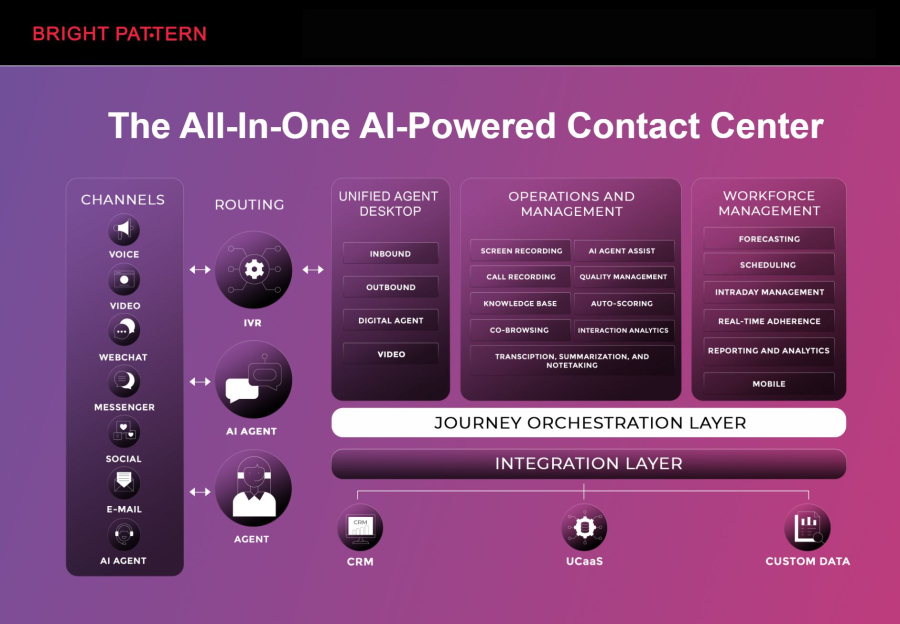
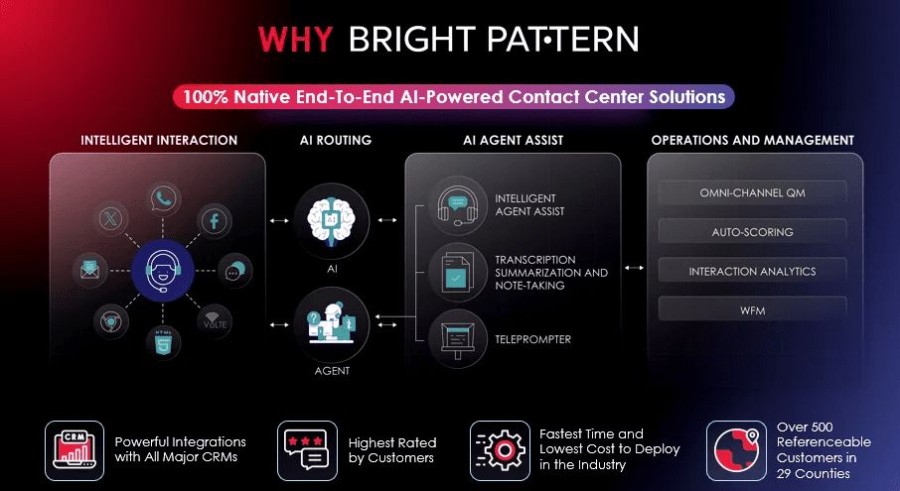
Bright Pattern stands out as a leading AI contact center platform designed to improve agent efficiency and customer satisfaction. Their solutions focus on providing real-time agent assist, omnichannel communication, and intelligent automation, making it easier for agents to deliver accurate and fast support across multiple channels.
Key features include:
- Real-time agent assist for on-screen guidance during calls, chats, and digital interactions
- Omnichannel routing to manage voice, chat, email, and social media in one platform
- AI-driven analytics for monitoring agent performance and customer interactions
- Intelligent automation to handle repetitive tasks and increase productivity
- Cloud-based infrastructure for scalable and secure deployment
Bright Pattern is ideal for businesses looking to enhance customer experience while optimizing agent workflows and response times.
2. Genesys – Comprehensive Customer Experience Solutions
Genesys provides AI-powered contact center software that supports real-time agent assist, predictive routing, and analytics for improving customer interactions.
3. Five9 – Cloud Contact Center Solutions
Five9 offers cloud-based call center solutions with AI integration, intelligent routing, and real-time agent guidance to improve operational efficiency.
4. Talkdesk – AI-Enhanced Contact Center Platform
Talkdesk combines cloud technology with AI to provide real-time support tools for agents, automated workflows, and advanced reporting features.
5. NICE inContact – Omnichannel Customer Experience
NICE inContact delivers AI-driven contact center solutions that include real-time agent assist, workforce optimization, and multichannel support.
6. RingCentral – Cloud Contact Center Software
RingCentral provides a cloud-based contact center platform that integrates AI for real-time agent assistance, analytics, and automated call management.
7. 8x8 Contact Center – AI-Driven Communications
8x8 offers a contact center solution with AI-enhanced tools for agent guidance, automated workflows, and unified communications across channels.
8. Cisco Contact Center – Enterprise Contact Solutions
Cisco’s contact center solutions feature AI-powered agent assist, advanced reporting, and intelligent call routing to streamline customer service operations.
9. Avaya OneCloud – Intelligent Customer Engagement
Avaya OneCloud provides cloud contact center services with real-time agent assist, AI chatbots, and analytics for better customer engagement and operational efficiency.
10. Aspect Software – Customer Interaction Management
Aspect Software offers AI-enhanced contact center solutions with real-time agent assist, workforce optimization, and automation tools to improve customer support workflows
What Is Real-Time Agent Assist?
Real-time agent assistis a technology that listens to or reads ongoing customer interactions and provides live recommendations to the agent. These recommendations might include:
- Relevant knowledge articles or troubleshooting steps
- Suggested replies or call scripts
- Next best actions based on customer intent and history
- Compliance or policy reminders to ensure conversations stay on track
- Sentiment and emotion indicators that help agents adjust their tone
Real-time assist is different from traditional knowledge bases or post-call analytics. Instead of asking agents to search for answers or waiting for after-the-fact analysis, the system works alongside them in the moment, guiding the conversation as it unfolds.
How It Differs From Chatbots and Self-Service
It is common to confuse real-time agent assist with chatbots or automated virtual agents, but they serve different purposes.
- Chatbots and virtual agentsinteract directly with customers, typically without a human in the loop.
- Real-time agent assistsupports thehumanagent, enhancing their performance and decision-making rather than replacing them.
In many organizations, both coexist. Chatbots handle simple tasks or deflect basic queries, while real-time assist empowers human agents to handle complex, high-value, or sensitive interactions with greater accuracy and empathy.
The Business Benefits of Real-Time Agent Assist
Real-time agent assist delivers measurable benefits across the contact center and beyond. When implemented effectively, it supports three key stakeholders: agents, customers, and operations leaders.
Benefits for Agents
- Higher confidence on every interactionbecause the system surfaces relevant content, troubleshooting steps, and suggested phrasing in real time.
- Less cognitive loadas agents no longer need to memorize complex policies, prices, or exceptions.
- Faster onboarding and skill rampfor new hires, who can perform like seasoned agents much sooner with live guidance always available.
- Reduced handle timebecause less time is spent searching knowledge bases or placing customers on hold to find information.
- More engaging workas agents can focus on connecting with customers rather than navigating tools.
Benefits for Customers
- Faster, more accurate resolutionsas agents quickly get to the right answers and actions.
- More consistent experiencesbecause guidance is standardized and aligned with current policies and best practices.
- Fewer transfers and escalationssince agents are better equipped to handle complex questions themselves.
- More empathy and personalizationwhen combined with sentiment cues and customer context surfaced during the interaction.
Benefits for Leaders and the Business
- Improved first contact resolutionas agents resolve more issues on the first interaction.
- Shorter average handle timewhile maintaining or improving quality scores.
- Higher quality and compliancethrough consistent prompts, reminders, and automated checklists.
- Reduced training costsbecause complex scenarios can be guided in the moment instead of front-loading training.
- Better insight into what worksby seeing which guidance and suggestions lead to successful outcomes.
When these benefits combine, real-time agent assist often delivers a strong return on investment by improving both customer satisfaction and operational efficiency.
Core Capabilities of Real-Time Agent Assist
While specific features vary by platform, most real-time assist solutions include a similar set of core capabilities. Understanding these helps you design use cases that align with your goals.
1. Live Interaction Understanding
Real-time assist typically uses technologies likeautomatic speech recognitionfor voice calls andnatural language processingfor both calls and chats. These components:
- Transcribe audio into text during live calls.
- Identify key topics, intents, and entities such as product names, order numbers, or account types.
- Detect sentiments and emotional cues such as frustration or satisfaction.
This real-time understanding is the foundation for providing timely and relevant guidance.
2. Knowledge and Answer Suggestions
Once the system recognizes what the conversation is about, it can surface:
- Relevant knowledge articles or help center content.
- Step-by-step troubleshooting flows.
- Policy summaries or pricing details tied to the topic.
Instead of a general search, the suggestions are contextual and adjust as the conversation evolves.
3. Suggested Responses and Scripts
Many real-time assist tools offer prewritten or dynamically generated responses such as:
- Opening and closing statements tailored to the interaction type.
- Empathy statements based on sentiment.
- Clarifying questions to better understand the customer issue.
- Product or service explanations in clear, customer-friendly language.
These suggestions reinforce consistent tone and messaging while still allowing agents to personalize and adapt.
4. Next Best Actions
Beyond information,next best actionrecommendations guide what the agent should do next. These may include:
- Offering a specific discount or retention offer when churn risk is detected.
- Triggering a follow-up process such as a service ticket or escalation.
- Walking through a particular workflow based on customer profile or issue type.
- Prompting for key verification or security steps at the right moment.
Next best action logic can be simple rule based, data driven, or enhanced with advanced analytics depending on your organization's maturity.
5. Compliance and Quality Prompts
Real-time assist is particularly valuable in regulated industries or quality sensitive environments. It can:
- Remind agents to read required disclosures or legal statements.
- Prompt for consent when recording or specific actions require approval.
- Highlight when an agent has missed a mandatory question or step.
- Flag sensitive language that should be avoided or reframed.
This live feedback helps protect the business and customers while reducing the need for heavy manual call monitoring.
6. Supervisor Visibility and Coaching Signals
Some solutions provide supervisors with real-time dashboards that show:
- Which conversations may need attention based on sentiment or escalation risk.
- Which guidance cards appear most frequently, revealing training needs.
- How agents respond to prompts, enabling targeted coaching.
Over time, leaders can refine guidance based on what produces the best outcomes.
Real-World Use Cases for Real-Time Agent Assist
Because real-time assist is flexible, it can be tailored to many environments. Below are some of the most impactful use cases across industries.
Customer Support and Service
- Complex troubleshootingfor technical products or services, where step-by-step flows reduce errors and callbacks.
- Billing and account questionswhere policy and pricing details change frequently and must be precise.
- Complaint handlingsupported by empathy prompts and de-escalation techniques when frustration is detected.
In these scenarios, real-time assist helps agents stay calm, focused, and accurate, even when dealing with emotionally charged interactions.
Sales and Revenue Generation
- Cross-sell and upsell recommendationsbased on customer profile, purchase history, and real-time intent.
- Guided discovery questionsthat help agents uncover customer needs before proposing solutions.
- Offer optimizationby suggesting the most relevant promotion or bundle during the call.
Real-time assist supports consistent, consultative selling while keeping conversations natural and customer centric.
Technical Support and Field Service
- Live diagnostic guidancefor agents helping customers or technicians troubleshoot equipment or software.
- Safety and compliance checklistspresented at the right step during the interaction.
- Part and service recommendationsbased on issue type and asset history.
By standardizing best practices, real-time assist helps technical teams solve issues correctly on the first attempt.
Onboarding and Training New Agents
- Guided flows for new scenariosso new hires are not overwhelmed by rare or complex cases.
- Shadow modethat lets supervisors see what guidance is shown and where agents struggle.
- Progressive enablementwhere guidance becomes less intrusive as agents gain proficiency.
This approach allows organizations to ramp new agents faster while keeping quality high from day one.
How Real-Time Agent Assist Works at a High Level
While technical implementations vary, most real-time assist solutions follow a similar flow behind the scenes.
Step 1: Capture the Interaction
- Forvoice calls, the audio stream is captured and passed to speech recognition components.
- Forchat, email, or messaging, the text is captured directly from the agent desktop or digital channel platform.
This capture typically happens through integrations with your contact center or communications platform.
Step 2: Understand the Conversation
The system then uses speech recognition and language understanding to:
- Transcribe spoken words into text.
- Identify customer intents, such as canceling a subscription or updating a payment method.
- Extract key entities like order numbers, product names, or locations.
- Estimate sentiment signals such as impatience, confusion, or relief.
This analysis is performed continuously so guidance can adapt as the interaction unfolds.
Step 3: Match to Guidance and Knowledge
Based on the current context, the system looks up relevant:
- Knowledge base articles and internal documentation.
- Call scripts or talk tracks.
- Compliance rules and required disclosures.
- Business rules for offers, workflows, or escalations.
Many organizations designplaybooksthat define which prompts should appear when certain intents, keywords, or emotional cues are detected.
Step 4: Present Guidance to the Agent
Finally, the guidance appears in the agent's desktop interface. Effective designs:
- Highlight only the most relevant guidance to avoid information overload.
- Use clear, concise language and visual structure that is easy to scan quickly.
- Allow agents to click for more detail when needed, rather than forcing long content by default.
- Stay synchronized with the conversation so outdated prompts are minimized.
At every step, the goal is to support the agent without distracting from the customer.
Implementing Real-Time Agent Assist in Your Organization
Successful adoption of real-time assist is as much about process and people as it is about technology. The following steps help you roll it out in a structured, low risk way.
1. Start with Clear Objectives
Before selecting or configuring a solution, define what you want to improve. Common objectives include:
- Reducing average handle time for specific call types.
- Improving first contact resolution rates.
- Increasing sales conversion or cross-sell rates.
- Reducing compliance errors or quality score deductions.
These goals will guide your use case selection and measurement strategy.
2. Prioritize High Impact Use Cases
Rather than trying to cover every interaction type immediately, focus on a few where guidance will have the biggest impact, such as:
- Complex, high volume call types that frequently lead to escalations.
- Interactions with high financial or compliance risk.
- Sales conversations where small improvements can significantly increase revenue.
By concentrating efforts, you can prove value quickly and learn what works before expanding.
3. Prepare and Curate Your Knowledge
Real-time assist is only as strong as the content it surfaces. Invest time in:
- Reviewing existing knowledge articles for accuracy and clarity.
- Breaking long documents into smaller, task oriented chunks that are easier to present in real time.
- Creating concise call flows and checklists for common scenarios.
- Standardizing wording for key messages and disclosures.
Many organizations use the rollout of real-time assist as a catalyst to modernize their knowledge strategy.
4. Involve Agents Early
Agents are the primary users, so their input is vital. Involve them by:
- Inviting experienced agents to help design playbooks and guidance prompts.
- Piloting with a small group and collecting feedback on usability and relevance.
- Incorporating their suggestions into regular iteration cycles.
When agents see that real-time assist genuinely helps them and that their feedback shapes the tool, adoption rates rise dramatically.
5. Integrate with Existing Systems
For a seamless experience, real-time assist should connect with:
- Your contact center or telephony platform to access live calls.
- Chat and digital messaging platforms for text based interactions.
- Customer relationship management systems to pull in relevant context such as account details or history.
- Knowledge and content repositories to surface the right information.
Streamlined integration minimizes the number of screens agents must monitor, which directly impacts usability.
6. Provide Focused Training
Even though real-time assist is intuitive, formal training helps embed best practices. Effective training covers:
- How and when to rely on suggestions versus personal judgment.
- How to offer feedback on inaccurate or unhelpful prompts.
- How the system supports quality, compliance, and performance metrics.
Emphasize that the tool is designed to support, not monitor or replace, agents. This builds trust and enthusiasm.
7. Iterate and Expand
After launch, monitor the results and agent feedback closely. Then:
- Refine prompts and playbooks based on which guidance drives positive outcomes.
- Add new use cases once early successes are confirmed.
- Regularly refresh content as products, policies, or processes evolve.
A continuous improvement mindset keeps your real-time assist program aligned with changing customer and business needs.
Best Practices to Maximize the Value of Real-Time Assist
The difference between an average implementation and a great one often comes down to a few practical design decisions.
Keep the Interface Clean and Focused
- Limit the number of prompts shown at any one time to avoid overwhelming agents.
- Use clear titles and short summaries so agents can quickly decide what to open.
- Organize guidance by type, for example knowledge, actions, or compliance.
The goal is to provide just enough context to be helpful, without diverting attention from the customer.
Balance Automation with Human Judgment
Real-time assist works best as a partner, not a strict script. Encourage agents to:
- Use prompts as a starting point and adjust phrasing to fit the conversation.
- Override or ignore suggestions that clearly do not apply in a particular context.
- Flag guidance that is outdated or confusing so it can be improved.
This balance maintains authenticity while still benefiting from standardization.
Design for New and Experienced Agents
New agents may need more structured flows, while experienced agents prefer fewer interruptions. You can address this by:
- Offering different guidance modes or levels of detail based on experience.
- Allowing agents to customize aspects of their view, such as which panels are visible.
- Gradually reducing prompt frequency as performance improves.
Tailoring the experience keeps the tool valuable throughout the agent lifecycle.
Protect Privacy and Build Trust
Because real-time assist often involves recording or analyzing conversations, it is important to:
- Follow applicable data protection and privacy regulations.
- Clearly communicate to agents how data is used and how it benefits them.
- Ensure sensitive information is handled and stored appropriately.
Transparent communication and strong governance help maintain confidence in the program.
Measuring Success: KPIs and ROI for Real-Time Agent Assist
To demonstrate value, link your real-time assist initiative to clear metrics. The table below highlights common key performance indicators and what they tell you.
Metric | What It Measures | How Real-Time Assist Helps |
First Contact Resolution (FCR) | Percentage of issues resolved in a single interaction. | Improves by surfacing accurate answers and next steps during the first call or chat. |
Average Handle Time (AHT) | Average time spent on each interaction. | Decreases as searching, hold time, and repeated explanations are reduced. |
Customer Satisfaction (CSAT) | Customer rating of the interaction experience. | Improves when agents resolve issues quickly while maintaining empathy and clarity. |
Quality and Compliance Scores | Adherence to scripts, processes, and regulations. | Rises through live reminders, checklists, and standardized messaging. |
Agent Ramp Time | Time for new hires to reach target performance. | Shortens thanks to step-by-step guidance and suggested responses. |
Sales Conversion Rate | Percentage of interactions that result in a desired sale or outcome. | Increases when agents receive timely cross-sell, upsell, and offer prompts. |
By tracking these metrics before and after rollout, you can build a strong business case and continuously refine your strategy.
Future Trends in Real-Time Agent Assist
Real-time assist capabilities are evolving rapidly. Organizations that adopt them today position themselves to benefit from increasingly powerful enhancements. Some emerging trends include:
- More natural guidanceas language models continue to improve, leading to suggestions that feel even more conversational and context aware.
- Deeper personalizationwhere guidance adapts not only to the customer but also to individual agent strengths and preferences.
- Proactive assistancethat can predict common issues during certain journeys and prepare agents before the customer even raises them.
- Multimodal supportcombining voice, text, and potentially screen context to offer even more precise guidance.
As these innovations mature, the line between coaching, knowledge management, and live support will blur, creating a unified experience that empowers agents and delights customers.
Bringing It All Together
Real-time agent assist is more than a new tool on the agent desktop. It is a strategic capability that transforms how your organization supports customers, drives revenue, and develops talent.
By giving agents live, context aware guidance, you help them handle complex interactions with confidence, speed, and empathy. Customers feel the difference in faster resolutions and more consistent experiences. Leaders see the impact in improved metrics and a more agile operation.
With clear goals, thoughtful design, and a focus on collaboration between technology and people, real-time agent assist can quickly become one of the most valuable assets in your customer experience strategy.
